
Introduction
Prompt engineering is sometimes described as a developer skill. That description sells it short. The ability to write structured, clear prompts is useful wherever AI tools are used, and those tools now appear across a wide range of roles and industries.
If you work with text, data, plans, or communications, and you use an AI tool to help, prompt engineering has something to offer you. The skill is not about coding. It is about communicating, and clear communication is not limited to any single profession.
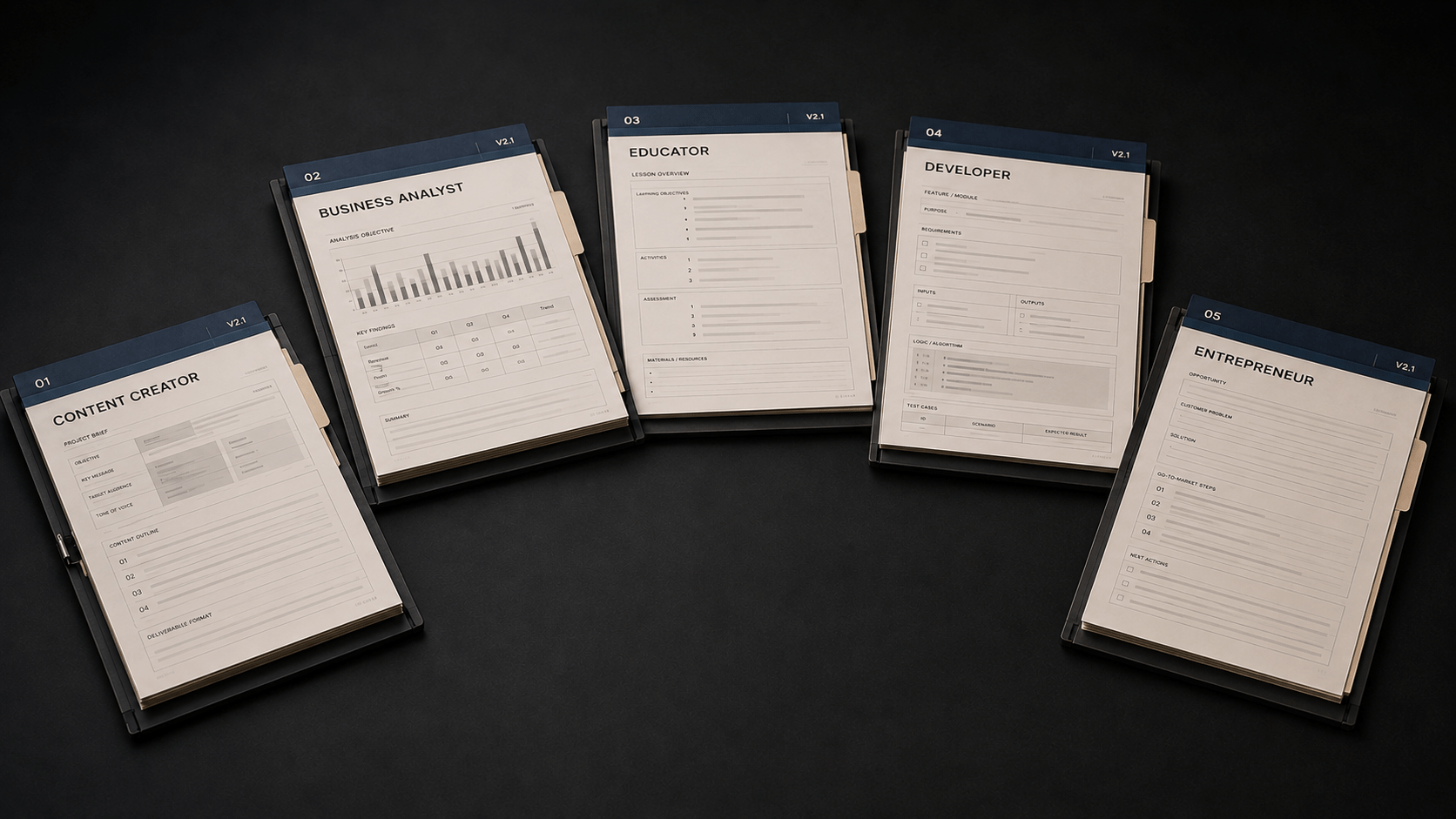
This article profiles five roles that consistently benefit from structured prompting. For each role, you will see how they typically use AI tools, what an unstructured approach tends to look like, and what a more deliberate, structured prompt produces instead.
These are not the only roles that benefit from prompt engineering. But they represent the most common patterns, and understanding them can help you see where your own practice fits.
Why Structured Prompting Applies Across Roles
Every role that interacts with an AI tool faces the same core challenge: the quality of the output depends heavily on the quality of the input. That is not a technical problem. It is a communication problem.
A vague request tends to produce a vague response. A request that includes the task goal, relevant context, intended audience, and required format, gives the model far more to work with. The result is often closer to usable on the first attempt, which means less time spent editing and rewriting.
This principle holds across roles, whether you are writing a lesson plan, summarizing a business report, or drafting a client email; the structure of your prompt shapes what you get back.
The five roles below each apply this principle in their own way. The tasks are different. The underlying method is the same.
Role 1: Content Creator
Content creators, writers, social media managers, newsletter authors, and video scriptwriters are among the most frequent users of AI writing tools. They produce high volumes of text-based content, often under time pressure, and consistency of voice and format matters.
Without structured prompting, content creators often receive outputs that are close but not quite right: wrong tone, wrong length, wrong platform, or generic rather than brand-specific. Each output requires significant editing before it is usable.
With structured prompts, they can specify brand tone, audience, platform, format, and character limits upfront. The result is a draft that typically needs minor refinement rather than a full rewrite.
Content creators who develop reusable prompt templates for their most common tasks, including weekly newsletter intros, product captions, and video hooks, tend to see the most time savings. The template captures the consistent elements; the creator fills in the variable details each time.
Role 2: Business Analyst
Business analysts work with structured data, reports, and documentation. They often need to summarize findings, build comparison tables, draft stakeholder updates, and turn raw information into clear, organized outputs.
A common pattern without structured prompting: the analyst pastes data or a long document into an AI tool and asks for a summary. The output is often too broad, misses key points, or uses the wrong level of technical detail for the intended audience.
With structured prompting, the analyst specifies what the summary should include, what it should exclude, who will read it, and what format it needs to follow. The output tends to be more directly usable.
Business analysts often find that the most useful applications are not one-off summaries but repeatable tasks, weekly report drafts, comparison tables across consistent criteria, or stakeholder email templates. Building prompt structures for these recurring tasks can meaningfully reduce the time spent on routine documentation.
Role 3: Educator
Educators, teachers, trainers, course designers, and instructional writers use AI tools to build lesson materials, quiz questions, rubrics, feedback templates, and course content. The challenge is producing materials that are accurate, appropriately leveled, and aligned with specific learning objectives.
Without structured prompting, educators often receive lesson plans or quiz questions that are either too generic or too advanced, and that require significant reworking to fit the actual classroom context.
With a structured prompt, the educator specifies the subject, grade or skill level, learning objective, and output format. The result is material that is much closer to what the classroom or course actually needs.
One common misconception this role helps address is the assumption that prompt engineering requires technical knowledge. It does not. The structured prompt above uses no jargon, only clear communication about what the output should accomplish.
Role 4: Developer
Developers use AI tools to accelerate code drafting, debug existing code, write documentation, and explain logic. They are often the role most associated with prompt engineering, but effective developer prompting is less about technical syntax and more about clearly specifying the problem context.
A developer who asks an AI tool to ‘fix this code’ without describing what the code is supposed to do, what the error is, or what constraints apply typically receives a generic fix that may not match the actual use case. A developer who specifies the language, the task the function performs, the error encountered, and any relevant constraints tends to get more targeted, usable suggestions.
Developers who use prompt engineering most effectively often build prompt templates for recurring documentation tasks, function descriptions, test case drafts, code review comments, and iterate on them across projects rather than starting from scratch each time.
Role 5: Entrepreneur and Small Business Owner
Entrepreneurs and small business owners often need to produce a wide range of written materials without a dedicated content, marketing, or communications team. Client emails, product descriptions, social media posts, SOPs, and customer updates all require writing, and all can benefit from structured prompting.
The key challenge for this role is consistency. When writing tasks are distributed across weeks and topics, tone and format tend to drift. Structured prompt templates help maintain consistency: the template captures the business voice and format requirements, and the owner fills in the specific details each time.
Entrepreneurs who build a small library of reusable prompt templates, one for client emails, one for product announcements, one for social media captions, tend to find that the time investment in building those templates pays off quickly across repeated tasks.
The Common Pattern Across All Five Roles
Each of the five roles above applies structured prompting differently. The tasks are not the same. The domains are not the same. But the underlying pattern is consistent.
| Role | Primary Prompting Need | Key Benefit |
|---|---|---|
| Content Creator | Consistent voice, platform-specific format | Less editing; faster content production |
| Business Analyst | Targeted summaries and structured outputs | Stakeholder-ready documentation with less rewriting |
| Educator | Level-appropriate, objective-aligned materials | Lesson-ready content that fits the actual classroom |
| Developer | Precise problem context and constraints | More targeted suggestions; less generic output |
| Entrepreneur | Consistent tone and format across business communications | Reusable templates that maintain brand voice |
The users who tend to get the most consistent value from AI tools are not always the most technically skilled. They are the ones who communicate most clearly with the system. Prompt engineering is the practice of building that communication clarity, and it is learnable regardless of your background or role.
Key Takeaways
- Who uses prompt engineering spans roles and industries; content creators, business analysts, educators, developers, and entrepreneurs all apply structured prompting in their daily work.
- The core benefit is the same across roles: a structured prompt gives the model clearer direction, which typically produces more usable output on the first attempt.
- Prompt engineering is a communication skill, not a technical one. No programming knowledge is required.
- Reusable prompt templates are one of the most practical outcomes of developing prompt engineering skills, especially for roles with recurring, consistent tasks.
- Results vary by task, context, model, and iteration. Structured prompting improves consistency; it does not guarantee any specific output.
What to Do Next
You have now seen how five common roles apply structured prompting in practice. The next step is to understand what, specifically, makes a prompt clear so that you can apply those principles to your own role and tasks.
Start by identifying one recurring task in your own work that involves AI output. What does your current prompt look like? What elements are missing? Chapters 2 through 4 of this book build the foundational skills you need to answer those questions systematically.