
Introduction
Visual AI tools make it easy to generate images and video clips in seconds. That ease is one of their biggest advantages. It is also the reason many people skip a step they should not.
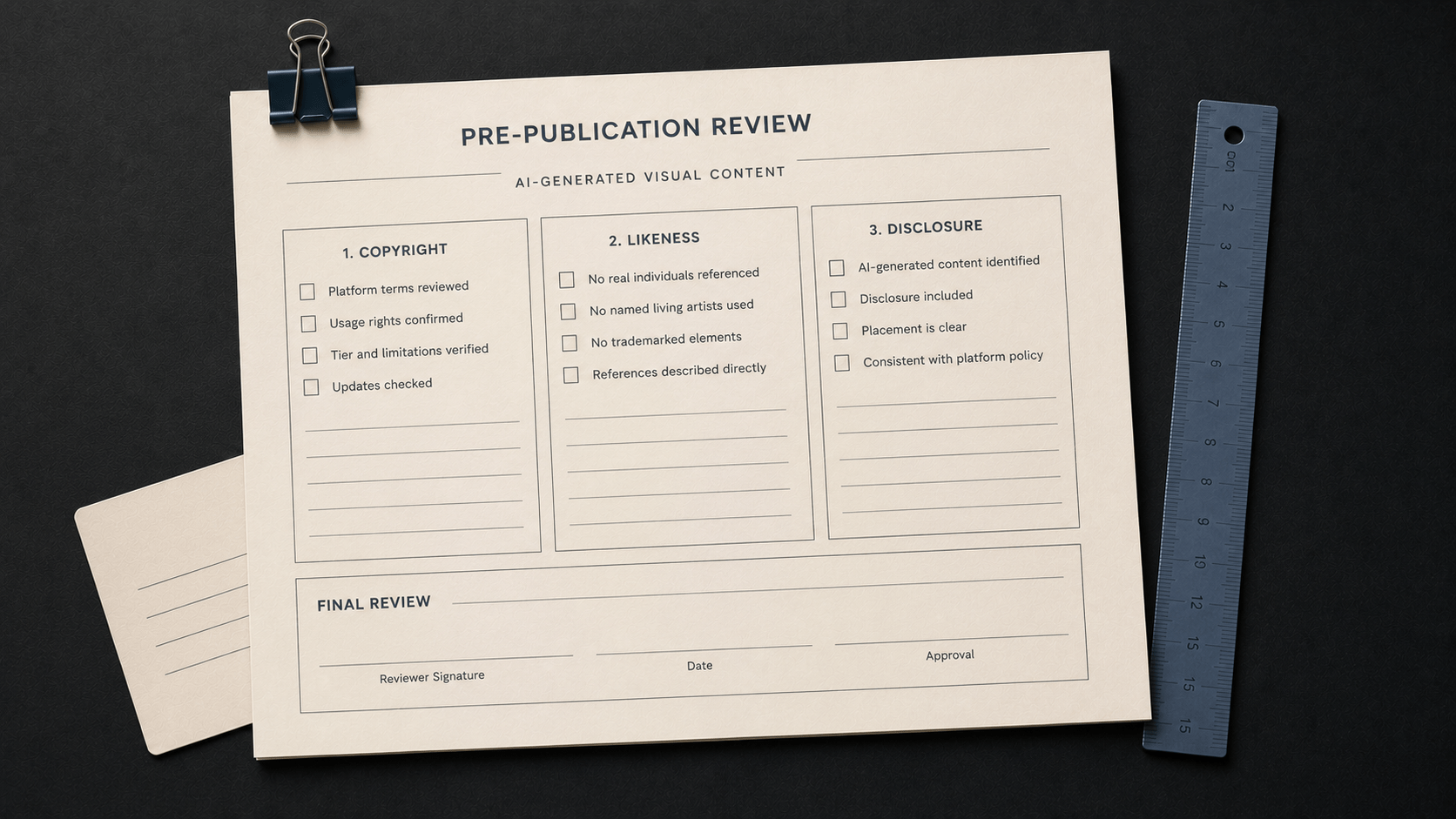
Before you publish, sell, or share AI-generated visual content, three responsibilities apply. They are not optional extras reserved for professionals with legal teams. They apply to anyone using these tools in a public, commercial, or client-facing context – and increasingly, they are beginning to apply in casual contexts too.
This article clearly breaks down each responsibility. By the end, you will understand what AI image ethics and copyright mean in practice, why likeness and reference matter, and how to build a disclosure habit that protects your credibility over time.
These are the practical foundations. A fuller treatment – covering bias detection, governance frameworks, and sector-specific compliance requirements – is addressed in Chapter 15.
Responsibility 1: Copyright and Ownership
When you generate an image using a tool like GPT Image or Nano Banana 2, or a video clip using Kling or Veo 3.1, a reasonable question follows: who owns that output?
The answer is not straightforward – and it is not the same across every tool.
Platform terms of service vary significantly on this point. Some tools grant users full commercial rights to generated outputs. Others retain certain usage rights for the platform. Others apply different conditions depending on which tier you are on – free users and paid subscribers may have different rights to the same type of output.
The regulatory landscape around AI-generated content is also actively evolving in many jurisdictions. Legal positions that apply today may change. Courts in multiple countries are still working through foundational questions about how copyright law applies to AI-generated works.
This means that assuming you have commercial rights to AI-generated visual content – because it feels like something you made – is not a safe approach.
What to do
- Read the terms of service for the specific tool you are using before you publish, sell, license, or otherwise distribute any AI-generated visual.
- Verify which tier you are on and what rights that tier specifically grants. Do not assume that paid and free tiers have the same usage rights.
- Check for updates to those terms periodically. Platform policies change – sometimes significantly.
- Do not apply what you read in one platform’s terms to another. Each tool has its own policy.
Note on training data and third-party copyright
A separate but related question is whether AI-generated images might reproduce elements from copyrighted training data in ways that create downstream risk. This area is legally unsettled and actively litigated. It is worth being aware of, particularly for commercial work. Legal guidance specific to your jurisdiction and use case is recommended for higher-stakes applications.
Responsibility 2: Likeness and Reference
Visual AI tools will often generate an output if you name a real person, reference a named living artist’s style, or describe something closely associated with a recognizable brand. The fact that the tool produces an output does not mean publishing or using that output is without risk.
Three categories deserve attention here.
Real individuals
Prompts that describe or name identifiable real people – celebrities, public figures, and private individuals – raise concerns about likeness rights, right of publicity, defamation, and misrepresentation. In many jurisdictions, using someone’s likeness for commercial purposes without consent creates legal exposure. Even non-commercial uses can cause harm if the generated content is misleading or damaging.
The practical guidance is direct: avoid writing prompts that name or describe identifiable real individuals in generated visual content intended for public or commercial use.
Named living artists
Requesting that a tool generate an image in the style of a specific named living artist raises ethical questions about attribution, consent, and economic impact. Even when no direct copyright claim arises, many artists have publicly objected to their styles being used as prompts without their permission.
A practical alternative: describe the visual qualities you want directly, rather than attributing them to a specific person. Instead of referencing a named illustrator’s style, describe the visual characteristics – the era, the medium, the color approach, the line quality. You get the direction you are looking for. You avoid the attribution problem entirely.
Trademarked visual brands
Prompts that attempt to reproduce the visual identity of trademarked brands – logos, packaging, product designs, branded characters – may generate outputs that infringe on intellectual property. This applies even when the output is stylistically approximate rather than exact.
If your work includes references to branded visual elements, review their use carefully before distribution, particularly in commercial contexts.
The practical reframe
The goal is not to avoid visual AI tools. The goal is to use them in a way that does not create downstream risk – for you, your clients, or the people whose work or identity might be referenced without consent.
Describing visual qualities directly, rather than referencing people or styles by name, is not a limitation. In many cases, it produces more controllable and consistent results anyway.
Responsibility 3: Disclosure
AI-generated visual content often looks indistinguishable from photography, illustration, or video produced by a human creator. That visual equivalence is part of what makes these tools useful. It is also the reason that disclosure matters.
Audiences, clients, and collaborators often have a legitimate interest in knowing whether visual content was created by a person or generated by an AI tool. In some professional and regulated contexts – journalism, advertising, legal proceedings, academic work – disclosure may be required. In others, the norm is still forming.
Waiting until disclosure is legally required is a reactive approach. Building a consistent disclosure practice now positions you ahead of where professional norms are heading – and it protects your credibility if questions arise later.
What disclosure looks like in practice
Disclosure does not need to be complex. A clear, consistent statement is sufficient as a starting practice:
Example disclosure statements:
“This image was created using an AI image generation tool.”
“This video clip was generated using an AI tool. It does not depict real events or real people.”
“Visual assets in this project were produced with AI generation tools. Final selection and editing by [Name].”
Apply disclosure consistently – in captions, footers, project documentation, or wherever your content appears. Inconsistent disclosure tends to undermine trust more than no disclosure at all.
Technical disclosure: provenance metadata
Several visual AI tools are beginning to embed provenance metadata directly into output files. This technical approach to disclosure records how an image or video was generated at the file level – independently of any caption or statement the creator adds.
Google’s Nano Banana 2 and Veo 3.1, for example, use SynthID watermarking and C2PA Content Credentials to identify AI-generated outputs. The Content Authenticity Initiative (CAI) – backed by Adobe, Microsoft, and others – is building interoperable standards for content provenance across the industry.
This infrastructure is still developing, and not all tools support it yet. But its presence signals the direction the industry is moving: toward more traceable, verifiable records of how visual content was made.
As a practitioner, it is worth knowing this infrastructure exists and being aware of which tools use it. As it matures, technical provenance will likely complement – and in some contexts replace – manual disclosure statements.
Why These Three Responsibilities Matter Now
These responsibilities are often treated as fine print. They tend to get addressed only after a problem has already occurred – a takedown notice, a client complaint, a reputational issue, or a question from a collaborator that turns uncomfortable.
Applying them before you publish is not a significant time investment. It is mostly a habit.
The regulatory and professional environment around AI-generated visual content is changing faster than most professional norms change. Tools are widely accessible. Output quality has crossed a threshold where casual users and professional practitioners produce visually comparable results. The norms and rules that govern that output have not fully caught up.
Building good practice now – reading terms before publishing, describing visual qualities instead of referencing individuals, disclosing AI use consistently – takes less time than correcting problems after the fact. It also positions you as someone who takes the use of these tools seriously.
That positioning matters increasingly, both professionally and for the broader credibility of AI-generated content in professional contexts.
Summary: The Three Responsibilities at a Glance
| Responsibility | Practical Action |
|---|---|
| Copyright and ownership | Read platform terms before publishing. Verify your tier’s rights. Check for updates. Do not assume rights carry across platforms. |
| Likeness and reference | Avoid naming real individuals or living artists in prompts. Describe visual qualities directly instead of attributing them to a person. Review use of trademarked brand elements. |
| Disclosure | Apply a consistent disclosure statement to public, commercial, and client-facing AI-generated visual content. Know which tools embed provenance metadata. Build the habit before it is required. |
Key Takeaways
- AI image ethics and copyright apply to anyone using visual AI tools in a public, commercial, or client-facing context – not only to professional creators or large organizations.
- Copyright and ownership of AI-generated visual outputs vary by platform and tier. Read the specific terms for the tool and account you are using before distributing any generated content.
- Avoid prompts that name real individuals or named living artists when generating visual content for distribution. Describe the visual qualities you want directly. This reduces risk and often produces more controllable results.
- Trademarked visual brand elements carry intellectual property protections that extend to AI-generated approximations. Review carefully before commercial use.
- Disclosure builds credibility and positions you ahead of evolving professional and regulatory norms. A consistent, clear statement is a practical and sufficient starting point.
- Technical provenance tools – including SynthID watermarking and C2PA Content Credentials – are being embedded into leading visual AI tools. This infrastructure will likely mature into a standard part of professional AI-generated content workflows.
- A fuller treatment of AI ethics, including governance frameworks and sector-specific compliance requirements, is covered in Chapter 15.