
Introduction
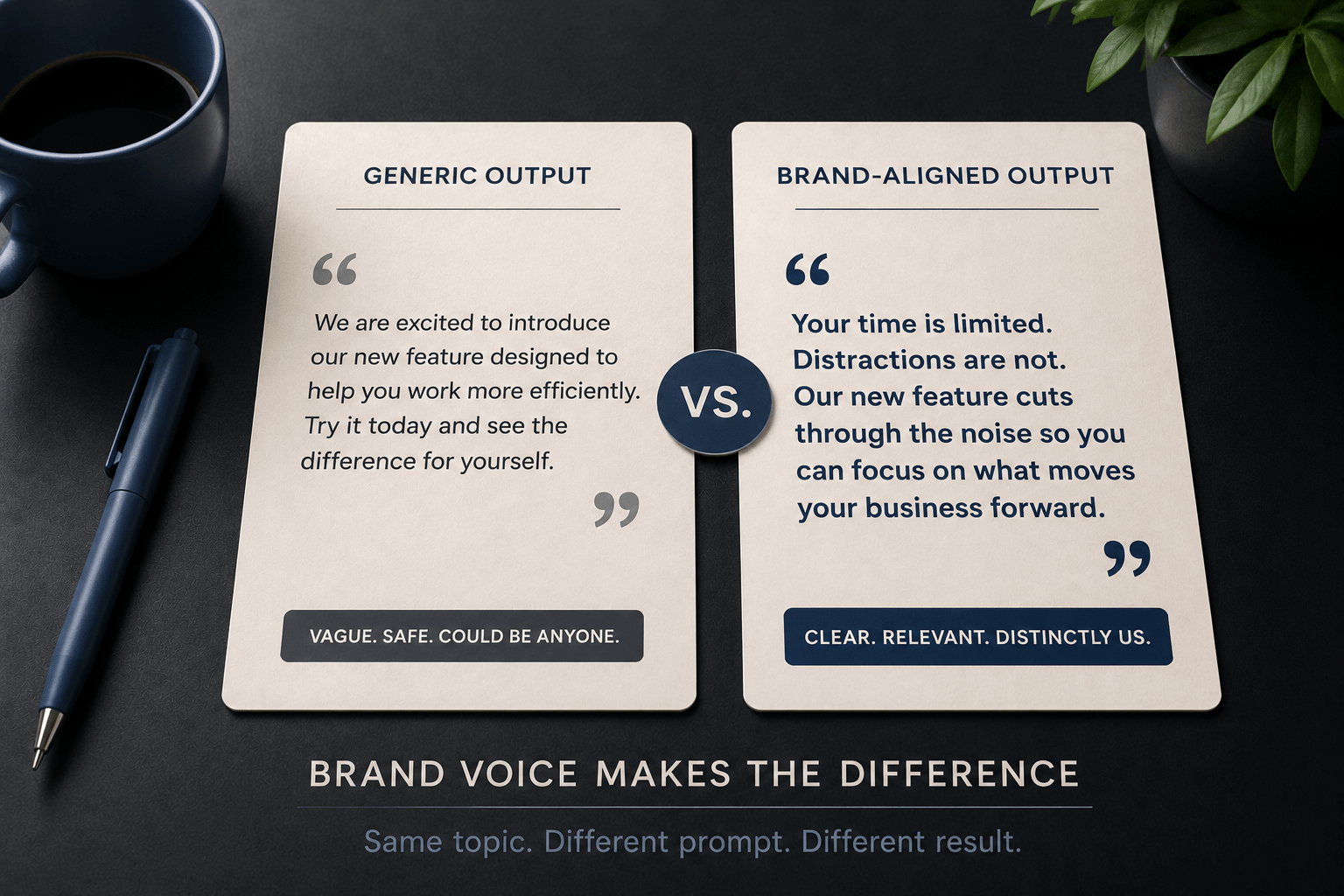
You have probably seen this scenario before. A marketer sits down, types a quick request into an AI tool, and gets back a draft that reads like it could belong to any company in any industry. The tone is neutral, the phrasing is safe, and the output is technically correct – but it feels like it was written for no one in particular.
Now imagine a second version of the same task. This time, the prompt includes who the reader is, how the brand communicates, what the writing should avoid, and what the piece needs to accomplish. The output reads like it was written by someone who knows the brand.
The difference between those two outputs is not the AI tool. It is the prompt. Specifically, it is whether brand voice guidance was included.
This article walks through that difference directly using a brand voice AI output comparison across four prompt components. You will see four side-by-side examples – one for each component – showing how each addition shifts the output from generic to on-brand. By the end, you will have a clear, practical sense of what each component does and why leaving any of them out tends to produce output that misses the mark.
What a Generic Output Looks Like – and Why It Happens
Generic AI output is not the result of a faulty tool. It is the predictable outcome of a prompt without enough structure.
When a prompt lacks brand voice guidance, the model produces text based on broad patterns from its training data. That typically means a neutral professional register, widely acceptable phrasing, and output that tends toward the average – useful, but not distinctive.
Here is a simple illustration. Both prompts below ask for the same piece of content. Only the level of structure changes.
| Prompt | Write a social media post about our new productivity feature. |
| Output | Introducing our newest feature – built to help you get more done in less time. Try it today and see the difference for yourself. #productivity #newfeature |
The output is grammatically correct and says something true. But it sounds like every productivity company everywhere. There is no sense of who is speaking, who the reader is, or what makes this brand different from the next one.
The sections below show exactly what changes – and how the output shifts – when you add each of the four brand voice components: tone descriptor, audience definition, style constraints, and content goal.
The Four Components and What Each One Does
A complete brand voice prompt has four components. Each one controls a specific dimension of the output. Here is a quick reference before the comparisons:
| Component | What It Controls | Without It |
|---|---|---|
| Tone Descriptor | The emotional register and personality of the writing | Output defaults to neutral, formal, or generically professional |
| Audience Definition | Who the reader is and what they care about | Output addresses a vague, undefined reader – no specificity |
| Style Constraints | What the writing should do and what to avoid | Output may use phrasing, structure, or tone the brand does not use |
| Content Goal | What the piece needs to accomplish for the reader | Output may be accurate but unfocused – no clear direction or outcome |
Each comparison below isolates one component. In each case, you will see the same base task – a social media post for a productivity software brand – with the component added, removed, or varied to show what it changes.
Comparison 1: Tone Descriptor
The tone descriptor tells the model the emotional quality and register of the language. It answers the question: how does this brand sound?
Without a tone descriptor, the model tends to produce a neutral, professional tone. That is not inherently wrong – but neutral is not the same as on-brand.
| Prompt | Write a 100-word LinkedIn post about our new time-tracking feature for project managers. |
| Output | We are excited to introduce our new time-tracking feature, designed to help project managers take control of their schedules. With real-time visibility into how time is allocated across tasks, your team can make smarter decisions and stay on track. Available now in your dashboard. Try it today. |
| Prompt | Write a 100-word LinkedIn post about our new time-tracking feature for project managers. Tone: direct and confident. No corporate language. No exclamation points. No ‘excited to announce’ phrasing. |
| Output | Time is the one resource you can’t recover once it’s gone. Our new time-tracking feature gives project managers real-time visibility into exactly how hours are being spent – not as a reporting tool, but as a planning one. See where your team’s time is going. Adjust before the deadline hits. It’s in your dashboard now. |
The content goal is the same in both versions. The tone descriptor is the only addition. Notice how the phrasing shifts: less formal announcement, more direct address. The second version sounds like it comes from a specific brand perspective rather than a generic company statement.
Comparison 2: Audience Definition
The audience definition tells the model who the reader is and what they care about. It answers: who is this written for?
Without an audience definition, the model produces content that could apply to any reader. The result often lacks the specificity that makes a piece feel relevant.
| Prompt | Write an Instagram caption about saving time with AI writing tools. Tone: practical, plain language. |
| Output | AI writing tools can help you save time on tasks that used to take hours. From drafting emails to writing reports, the right tool can make a real difference. Save this post to remember it for later. |
| Prompt | Write an Instagram caption about saving time with AI writing tools. Tone: practical, plain language. Audience: freelance content writers, 28-40, who feel pressure to produce more content than their schedule allows. |
| Output | You have six pieces of content to write this week and exactly the same number of hours you always have. AI writing tools are not about replacing your voice – they are about giving you a faster start so you spend your time editing and refining, not staring at a blank page. Save this if that sounds familiar. |
The second output addresses a specific situation the reader recognises: too much content, not enough time. The first addresses no one in particular. Adding the audience definition shifted the output from a general statement about AI tools to a message that speaks to a real problem this reader faces.
Comparison 3: Style Constraints
Style constraints define what the writing should do and, equally important, what it should avoid. They answer: what are the rules for this piece?
Without style constraints, the model defaults to patterns that may not align with the brand’s established voice. Common defaults include superlatives, urgency language, and promotional framing – all of which can conflict with a brand that communicates in a specific way.
| Prompt | Write a 150-word blog intro about sustainable packaging for a lifestyle brand. Tone: warm and encouraging. Audience: environmentally conscious adults, 30-45. |
| Output | Are you ready to make a difference? Sustainable packaging is one of the most impactful changes you can make right now. The best brands are already switching – and the results have been incredible. Join the movement and discover why sustainable choices are the smartest ones you can make for your business and our planet. |
| Prompt | Write a 150-word blog intro about sustainable packaging for a lifestyle brand. Tone: warm and encouraging. Audience: environmentally conscious adults, 30-45. Style constraints: no urgency language, no superlatives, no guilt-based framing, no calls to ‘join a movement.’ Plain sentences. |
| Output | Switching to sustainable packaging does not have to be complicated. For many small brands, it starts with one product line, one supplier conversation, or one material swap. The changes can be small, and they do add up over time. This guide covers three practical options that work well for lifestyle brands – including what to look for, what to ask suppliers, and what the shift typically involves. |
The first output uses pressure language and superlatives that many sustainable brands actively avoid. The second respects the reader without pushing them. Style constraints are the mechanism that prevents the model from reaching for phrasing the brand does not use.
Comparison 4: Content Goal
The content goal tells the model what the piece needs to accomplish for the reader. It answers: what should the reader take away or do after reading this?
Without a content goal, the output may cover the topic accurately but end without direction. The piece exists – but it does not accomplish anything specific.
| Prompt | Write a 120-word email for a wellness brand about our new guided meditation app feature. Tone: calm, supportive. Audience: existing subscribers who already use the app. |
| Output | We are happy to share that a new guided meditation feature is now available in your app. Whether you are new to meditation or building an existing practice, this feature offers a range of sessions designed to fit your routine. We hope you enjoy exploring it. Log in to your account to get started. |
| Prompt | Write a 120-word email for a wellness brand about our new guided meditation app feature. Tone: calm, supportive. Audience: existing subscribers who already use the app. Content goal: help the reader feel ready to try the feature this week – not pressured, just informed and gently invited. |
| Output | If you have been meaning to build a steadier meditation habit, the new guided sessions in your app might be a good place to start. They range from five minutes to twenty – no prior experience needed. You can filter by goal: sleep, focus, or general calm. There is no right time to try it. Whenever you have a few minutes, it will be there. No pressure. Just an option, when you are ready. |
The first output informs. The second invites. The content goal gave the model a specific outcome to aim for – not just a topic to cover. That single addition shifted the output from a notification into something that genuinely serves the reader.
Putting It Together: Full Brand Voice Prompt vs. No Brand Voice
The comparisons above isolated each component. Below is a final side-by-side showing what happens when all four components are present versus absent – using the same task.
| No Brand Voice Guidance | Full Brand Voice Prompt |
|---|---|
| Prompt: Write a 100-word LinkedIn post about our project management app. | Prompt: Write a 100-word LinkedIn post about our project management app. Tone: direct, confident, no corporate language. Audience: ops managers at companies with 20-100 staff who feel their current tools create more admin than they solve. Style: no urgency language, no superlatives, short sentences. Content goal: help the reader see one specific way the app reduces admin burden – leave them curious, not sold. |
| Output: We are thrilled to introduce our latest project management solution – built to help teams collaborate, plan, and execute more effectively. Whether you are managing a small team or a large enterprise, our platform has everything you need to stay on track. Try it free today. | Output: Most project management tools add a layer of admin on top of the work that already exists. Ours is built to remove a layer instead. If your team spends more time updating status fields than doing actual work, that is worth a look. One feature most ops managers notice first: automated progress updates that pull from existing tasks. No manual entry. No extra step. |
The first output is polished but generic. The second speaks to a specific reader about a specific problem in a specific tone. Both took roughly the same amount of time to generate. The difference is the structure in the prompt.
Common Mistakes in Brand Voice Prompting
Mistake 1: Using one tone word without elaboration
‘Friendly’ or ‘professional’ as a standalone tone descriptor leaves too much to interpretation. Those words mean different things in different brand contexts. A tone descriptor is more effective when it names the emotional register and includes at least one constraint – for example, ‘warm and encouraging, but no pressure language and no superlatives.’
Mistake 2: Defining the audience by demographics only
‘Adults aged 25-40’ tells the model very little about how to speak to that reader. An effective audience definition includes what the reader cares about, what problem or situation they are in, and what would make the content relevant to them. Demographics alone tend not to shift the output meaningfully.
Mistake 3: Skipping the content goal for short pieces
It is easy to skip the content goal for a short social post or email. In practice, the content goal has a strong effect on short-form output – it determines whether the piece ends with direction or just stops. A single sentence describing what the reader should feel, think, or do at the end tends to produce noticeably more focused output.
Key Takeaways
- Generic AI output is not a tool problem – it is a prompt structure problem. A brand voice AI output comparison like the ones in this article makes the gap visible: without brand voice guidance, the model defaults to a neutral register that belongs to no brand in particular.
- Each of the four components controls a specific dimension of the output: tone descriptor shapes register and personality, audience definition focuses the writing on a specific reader, style constraints prevent defaulting to phrasing the brand avoids, and content goal gives the output a direction.
- Removing any one component tends to produce output that drifts in that dimension. The comparisons above show this clearly: a prompt without an audience definition produces output for no one; a prompt without style constraints often reaches for urgency or superlatives.
- The brand voice prompt structure does not guarantee on-brand output in every instance. It narrows the output space significantly in many cases, which typically reduces the editing needed to reach a usable draft.
- For recurring content types, these four components can be fixed in a content brief template. You update the variable fields per piece – keyword, specific topic, CTA – and keep the tone, audience, and constraints consistent across all content of that type.