
Introduction
You have probably noticed that AI-generated content does not always sound like you. The post is readable. The grammar is clean. But something feels generic – like it could have been written for any brand, any audience, any industry.
The gap is almost never the AI. It is the prompt.
When a content prompt does not specify who you are talking to, how you want to sound, what you want to avoid, and what the piece needs to accomplish, the model fills those gaps with defaults. Generic defaults. The output reflects the model’s sense of a professional register – not yours.
Brand voice prompt writing is the skill of translating your brand’s communication style into structured prompt instructions. When it works, the model produces a first draft that sounds like you – or at least close enough to edit quickly. When it does not, you spend more time rewriting than the AI saved you.
This guide walks you through the four components of a brand voice prompt: tone descriptor, audience definition, style constraints, and content goal. You will see what each component does, how to write it clearly, and how to assemble the four into a single prompt that produces more consistent, on-brand drafts.
The approach works for blog posts, social media captions, email copy, and any other content type where voice and audience matter.
Why a Single Tone Word Is Not Enough
Most content prompts that struggle with brand alignment follow a similar pattern. The writer includes a tone word – “professional,” “friendly,” or “conversational” – and expects the model to understand what that means for their specific brand.
The problem is that tone words are interpreted broadly. “Friendly” can mean warm and informal for a consumer brand, approachable but precise for a healthcare provider, or casual and direct for a tech startup. Without further definition, the model defaults to a broadly acceptable interpretation that may not match any of those.
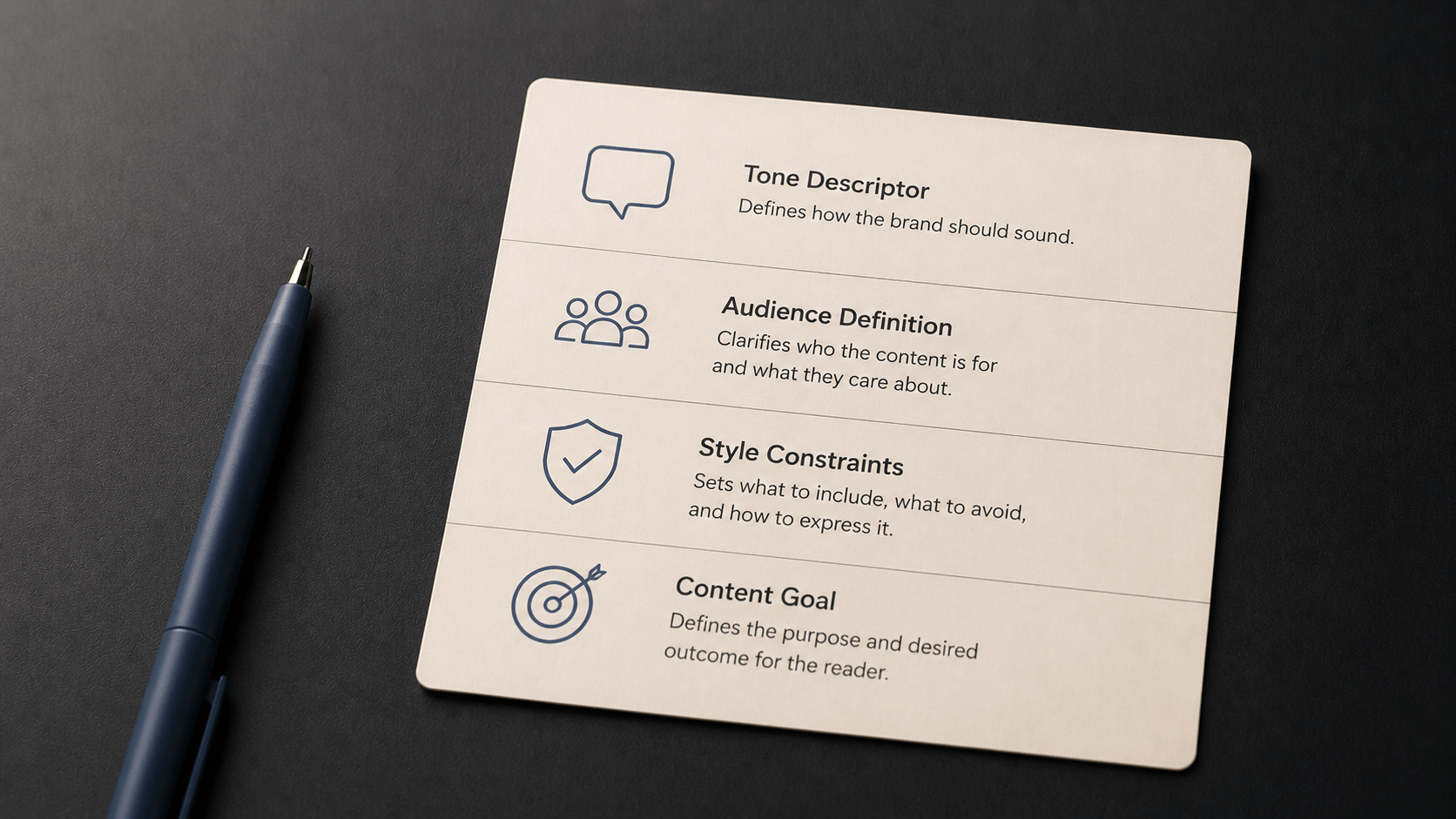
A complete brand voice prompt uses four components together. Each one does a different job. Skipping one leaves a gap the model fills on its own.
| Component | What It Controls | Why It Matters |
|---|---|---|
| Tone Descriptor | The emotional quality and register of the language | Prevents the model from defaulting to a neutral, generic register |
| Audience Definition | Who the reader is and what they care about | Shapes word choice, assumed knowledge, and framing |
| Style Constraints | What the writing should do – and what it must avoid | Catches the specific language patterns that erode brand voice |
| Content Goal | What the piece needs to accomplish for the reader | Directs the model toward a specific outcome, not just a topic |
The sections below explain each component and show you how to write it.
Component 1 – Tone Descriptor
The tone descriptor tells the model the emotional quality and register of the language. It is the closest thing to a personality instruction for the output.
A useful tone descriptor does two things. It names the quality you want, and it names the quality you want to avoid. This pairing is more precise than a single descriptor because it tells the model what to steer away from – not just what to aim for.
| Weak | Tone: friendly |
| Stronger | Tone: calm and encouraging, not preachy or urgent. Warm without being effusive. |
The second version tells the model what to avoid (preachy, urgent, effusive) alongside what to aim for. That pairing is especially useful for brands with a specific voice that gets blurred when the model defaults to a generic professional tone.
A few practical guidelines for writing tone descriptors:
- Use two to four descriptors, not one. A single word is too narrow to anchor a consistent register.
- Pair positives with negatives. “Warm but not sentimental” is more useful than “warm” alone.
- Use language from your brand guidelines if you have them. Exact phrasing from your own documentation tends to land more precisely than paraphrases.
- Avoid abstract qualities like “authentic” or “genuine.” These do not translate into language patterns the model can act on.
Component 2 – Audience Definition
The audience definition tells the model who the reader is and what they care about. It is the most frequently skipped component in content prompts – and one of the most consequential.
When the audience is defined clearly, the model adjusts its word choices, assumed knowledge, framing, and level of detail to fit that reader. When it is not defined, the model writes for a general adult reader with moderate familiarity with the subject. That default is serviceable but rarely on-target.
An effective audience definition includes three elements: who the reader is, what they want, and what they struggle with.
| Basic | Audience: small business owners. |
| More specific | Audience: small business owners, typically 1-10 person teams, who handle their own marketing without a dedicated team. They want practical guidance they can act on today, not theory. They are skeptical of hype and do not have time for long explanations. |
The second version gives the model enough information to shape the draft differently. Shorter explanations. Practical framing. A skeptical-reader tone. These adjustments do not require additional prompt instructions – the audience definition carries them.
One practical shortcut: describe your reader the way you would describe them to a new colleague before a client call. What does this person need? What would make them distrust the content? That framing tends to produce more useful audience definitions than demographic descriptors alone.
Component 3 – Style Constraints
Style constraints define the language rules that keep the output aligned with your brand voice. They are the guardrails – the list of things the model should consistently do and consistently avoid.
Without style constraints, the model applies its own defaults: a moderately formal register, balanced sentence lengths, and broadly inoffensive phrasing. That is not wrong, but it often does not match a specific brand’s voice.
Effective style constraints address three areas:
- Sentence and structure rules: “Short sentences. No passive voice. Subheadings every 150 words.”
- Language to avoid: “No superlatives. No urgency language. No jargon without explanation.”
- Format rules specific to the piece: “No numbered lists in the intro. One CTA at the end only.”
The most useful style constraints are the ones that catch the specific patterns that erode your brand voice. If your brand consistently sounds too corporate when AI-drafted, the constraint to add is: “Avoid formal corporate phrasing. Write the way you would explain this to a colleague over coffee.”
Example – Before and after with style constraints:
| Prompt | Write an Instagram caption about our new sustainable packaging for eco-conscious shoppers. |
| Sample Output | We are thrilled to introduce our revolutionary new sustainable packaging! This game-changing solution is the ultimate choice for eco-conscious consumers who want to make a difference. Shop now and be part of the change! #sustainability #ecofriendly #shopnow |
| Prompt | Write an Instagram caption about our new sustainable packaging for eco-conscious shoppers. Style constraints: No superlatives (“revolutionary,” “game-changing,” “ultimate”). No urgency language. No exclamation marks. Keep it conversational and grounded. Under 80 words. |
| Sample Output | Our new packaging is made from 100% recycled materials and designed to break down – not hang around. Smaller. Lighter. Simpler. Something we have been working on for a while, and we are glad it is finally here. #sustainablepackaging #ecofriendly #lessplastic |
The style constraints did not change the topic. They changed the register. That is what style constraints are for.
Component 4 – Content Goal
The content goal tells the model what the piece needs to accomplish for the reader. It is distinct from the topic. The topic is what the article is about. The content goal is what the reader should be able to do, feel, or understand after reading it.
Without a content goal, the model produces content that covers a topic rather than content that achieves an outcome. The difference shows up in the draft’s structure, closing, and overall direction.
| Topic-only | Write a blog post about sustainable home habits. |
| Topic with content goal | Write a blog post about sustainable home habits. Content goal: Help the reader choose one habit they can start this week without buying anything new. Leave them feeling capable – not overwhelmed by the scale of the problem. |
The second version shapes the closing, the tone, and the level of detail in the tips. The model knows the piece should narrow toward a single actionable step – not cover the full landscape of sustainable living.
A practical way to write a content goal: finish this sentence – “After reading this, the reader should be able to…” or “After reading this, the reader should feel…” That completion is your content goal.
One note on scope: keep the content goal specific and achievable within the piece. If the goal is too broad – “understand the full landscape of sustainable living” – the model will write a broad overview. If it is appropriately narrow – “take one action this week” – the model will write toward that specific outcome.
Assembling a Brand Voice Prompt: All 4 Components
Here is a complete brand voice prompt using all four components, labeled by component. The scenario is a sustainable lifestyle brand writing a weekly blog post for its audience of environmentally conscious adults.
| Tone Descriptor | Write in a calm, optimistic tone that feels encouraging without being preachy. Avoid urgency language and guilt-based framing. |
| Audience Definition | The reader is an environmentally conscious adult, aged 28-45, who wants to live more sustainably but finds the scope of the problem overwhelming. They are skeptical of all-or-nothing messaging. |
| Style Constraints | Use plain language. Short sentences. No jargon. No superlatives (“best,” “must-have”). No guilt-based framing. No numbered lists in the intro. |
| Content Goal | Help the reader choose one small, actionable sustainable habit they can start this week without buying anything new. Leave them feeling capable, not guilty. |
You would complete this prompt by adding an output format instruction – the structure, length, and subheading guidance for the specific piece. The brand voice components stay consistent across every piece of the same type. What changes is the output format and the specific topic for each use.
This is the core value of the four-component structure: you write the voice layer once. You update the format and topic per piece. Over time, that saves significant rework.
Common Mistakes When Writing Brand Voice Prompts
Three patterns appear regularly when brand voice prompts fall short. Each one is straightforward to fix once you recognise it.
Mistake 1: Writing tone descriptors without opposites
A tone descriptor that only names what you want – without naming what to avoid – leaves the model significant interpretive room. “Confident” can mean assertive and clear. It can also mean formal and slightly distant.
The fix: Add the opposite of what you want to avoid. “Confident but not cold.” “Clear without being blunt.” This pairing is more precise than a single descriptor and typically produces more consistent outputs across multiple uses of the same prompt.
Mistake 2: Using demographic labels instead of reader descriptions
“Audience: millennials” tells the model very little it can act on. Demographic labels are categories. What the model needs is a description of the reader’s situation, concerns, and goals.
The fix: Write the audience definition as a short reader portrait, not a demographic tag. “Adults in their 30s who are building a home office for the first time and feel out of their depth” is the kind of description the model can use to shape word choice, assumed knowledge, and framing.
Mistake 3: Setting a topic without a content goal
“Write a blog post about X” sets the topic. It does not tell the model what the piece should accomplish for the reader. Without a content goal, the output tends to be a general overview – technically accurate, but directionless.
The fix: Add a one-sentence content goal that completes the prompt: “Help the reader understand the difference between X and Y so they can make a confident choice.” That sentence shapes the structure, the emphasis, and the closing of the piece.
Key Takeaways
- A tone descriptor is stronger when it pairs the quality you want with the quality you want to avoid. Single-word tone instructions leave the model too much interpretive room.
- An audience definition works best when it describes the reader’s situation, goals, and concerns – not just a demographic category. The more specific the portrait, the more the model can shape word choice and framing to fit.
- Style constraints catch the specific language patterns that erode brand voice. Write them as rules: what to do and what to avoid. The patterns you list most explicitly are the ones most likely to be consistent across uses.
- A content goal tells the model what the piece should accomplish for the reader – not just what topic it covers. This shapes the draft’s direction, structure, and closing more than the topic instruction alone.
- The four components work as a system. Skipping one leaves a gap the model fills with defaults. Using all four produces more consistent, on-brand drafts in many cases – though results vary by model, task complexity, and how specifically each component is written.
- Brand voice prompt writing gets faster over time. Write the voice layer once. Update the format and topic per piece. This is where brand voice prompts generate lasting workflow value.