
Introduction
You have written your system message. You have designed the opening sequence. You have built an edge-case handling note and set your reset trigger. On paper, the conversation flow looks right.
But does it actually work?
A well-designed conversational AI flow is not proven by reading it – it is proven by running it. Testing reveals gaps that design work alone cannot catch: the turn where the persona quietly drifts, the off-topic question that slips through without a redirect, the moment the bot starts repeating itself because the context window has grown too large.
This article gives you a structured checklist to test conversational AI flow before you deploy it – seven points, one per failure mode, each drawn directly from the testing and design principles covered in Chapter 5 of Learning Prompt Engineering.
If you have not yet built a conversation template, review the template structure in Chapter 5 first. This checklist is the next step after that template is in place.
Why Testing Conversational Flows Is Different from Testing Single Prompts
Testing a single prompt is relatively straightforward. You write the prompt, run it, review the output, and adjust as needed. The interaction is self-contained.
Conversational flows work differently. Each turn builds on the turn before it. An error in Turn 3 may not surface until Turn 8. Persona drift tends to be gradual. Context crowding builds slowly. These are not failures that appear all at once – they compound over time.
That is why structured testing is essential before any conversational flow goes live. You need to run the flow through multiple scenarios, review the transcripts, and check each element deliberately. Ad hoc testing – running a quick chat and seeing how it feels – misses the failure modes that only appear under specific conditions.
One important note: base AI models have no memory between sessions. When you start a new test run, the model begins with no knowledge of prior sessions. This means each test run is genuinely independent. That is useful for structured testing – every scenario starts from a clean slate. It also means your design must collect whatever context it needs at the start of every session. Do not design around memory the model lacks.
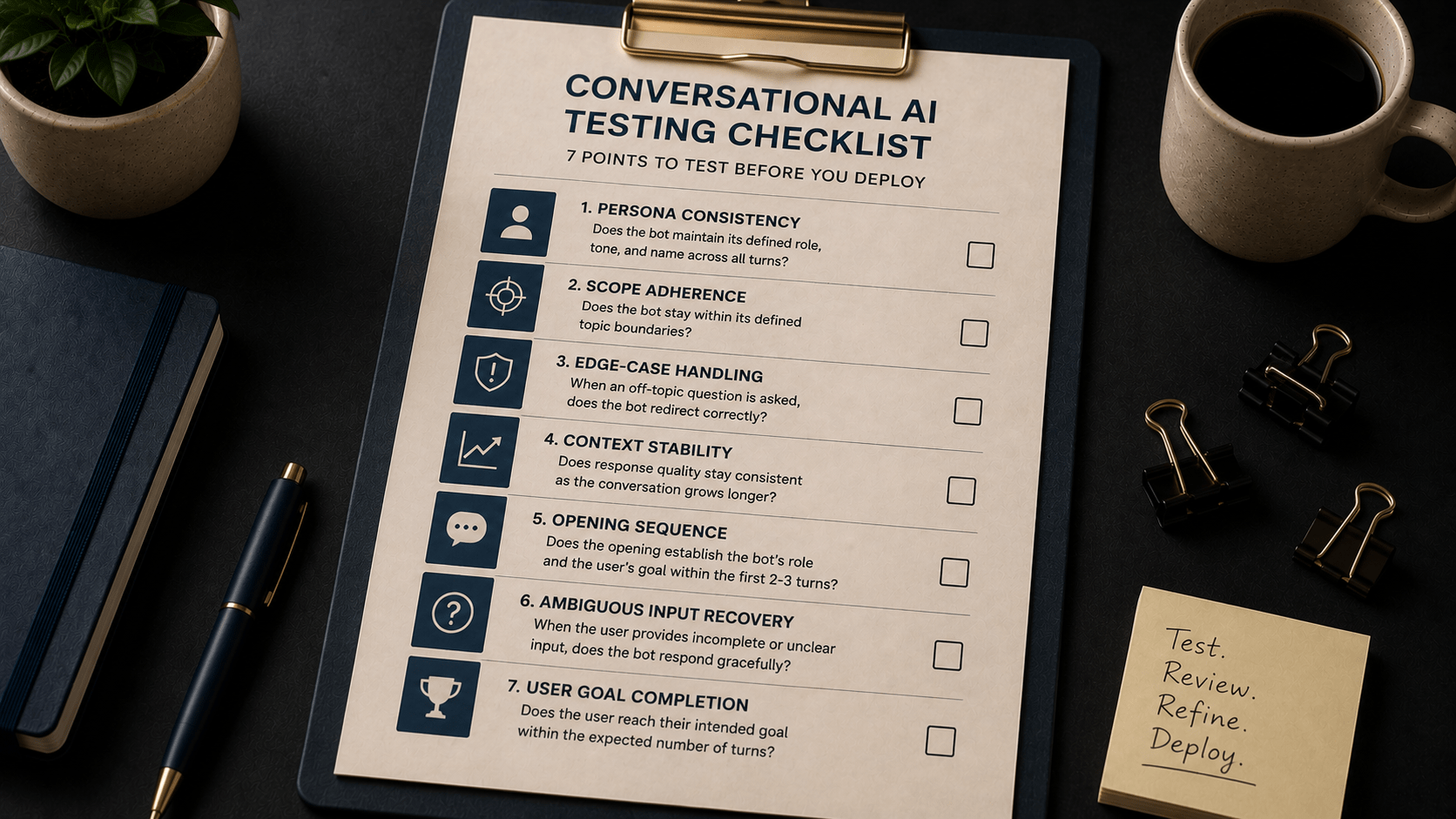
The 7-Point Testing Checklist
Run this checklist after each test session. For each item, record a pass or fail. For each fail, note the specific turn where the problem appeared and what adjustment you plan to make.
| # | Check Area | What to Verify | What to Look For |
|---|---|---|---|
| 1 | Persona Consistency | Does the bot maintain its defined role, tone, and name across all turns? | Tone shifts, name changes, or role drift between turns |
| 2 | Scope Adherence | Does the bot stay within its defined topic boundaries? | Out-of-scope answers appearing without a redirect |
| 3 | Edge-Case Handling | When an off-topic question is asked, does the bot redirect to the correct topic? | Missing redirect, generic response, or partial answer on a restricted topic |
| 4 | Context Stability | Does response quality stay consistent as the conversation grows longer? | Increasing vagueness, repeated phrasing, or persona slippage in later turns |
| 5 | Opening Sequence | Does the opening establish the bot’s role and the user’s goal within the first 2-3 turns? | Ambiguous opening, missing role introduction, or delayed goal-setting |
| 6 | Ambiguous Input Recovery | When the user provides incomplete or unclear input, does the bot respond gracefully? | Errors, unhelpful responses, or broken flow on vague user messages |
| 7 | User Goal Completion | Does the user reach their intended goal within the expected number of turns? | Incomplete resolution, circular loops, or early handoff without resolution |
Work through each point in order. The first four items address the core structural properties of the flow. The last three address the user experience and outcome quality.
Checkpoint 1: Persona Consistency
The persona you define in your system message shapes the bot’s role, tone, and name for the entire conversation, in theory. In practice, persona consistency tends to erode as a conversation grows longer and the context window fills.
What to test: Run the conversation to 10 or more turns. After Turn 6, review the bot’s tone and compare it to the system message. Does it still match the defined voice? Does the bot still use the correct name if one was given? Does the level of formality remain consistent?
Common failure: The bot gradually adopts a more generic tone, drops the persona’s name, or shifts out of the defined register. This is context drift – the system message is being pushed out of range as the conversation grows.
The fix: Add a grounding prompt at the point where drift first appears. If drift appears consistently at Turn 8, insert the grounding prompt after Turn 6 to catch it early. Adjust and retest.
| Grounding prompt | Reminder: You are Finn, the Flowdesk onboarding assistant. Your role is to help users with account setup, integrations, and first-project navigation. Keep responses brief and encouraging. Decline all other topics and redirect to support. |
Checkpoint 2: Scope Adherence
Scope adherence is the bot’s ability to stay within the topic boundaries defined in the system message. A bot with a well-defined scope should engage with relevant questions and redirect off-topic ones. Testing scope means verifying both sides of that behavior.
What to test: Run the flow with a mix of in-scope and out-of-scope questions. Confirm the bot answers in-scope questions accurately and redirects out-of-scope questions with the appropriate response.
Common failure: The bot attempts to answer out-of-scope questions rather than redirecting. This typically happens when the constraints section of the system message is missing or under-specified.
The fix: Add or tighten the constraints section of your system message. Include an explicit redirect script so the model has a clear pattern to follow—Retest with the same out-of-scope questions.
| Constraints addition | If the user asks about topics outside billing and payments, say: “That’s outside what I can help with here. For [topic], please get in touch with our support team or visit the Help Center.” |
Checkpoint 3: Edge-Case Handling
Edge cases are the questions and inputs your flow was not primarily designed for: vague requests, frustrated users, off-topic questions, multi-part questions that span different topics. Real users produce these regularly.
What to test: Deliberately test at least three edge cases: one off-topic question, one ambiguous or incomplete input, and one frustrated or emphatic user message. Review how the bot responds to each.
Common failure: The bot attempts to answer off-topic questions, produces a generic error-like response to ambiguous input, or fails to acknowledge a frustrated user’s tone before redirecting. Without an edge-case handling note in the system message, the model often defaults to answering rather than redirecting.
The fix: Add edge-case handling instructions to your system message or conversation template. Specify how the bot should respond to vague inputs, frustrated users, and questions outside its scope. Retest each scenario after the fix.
Checkpoint 4: Context Stability
Context stability measures whether the quality and consistency of responses hold as the conversation grows longer. Earlier in the conversation, the system message and recent exchanges are both in active range. Further in, earlier instructions may be pushed out as the context window fills.
What to test: Run the flow to 15 or 20 turns. Compare the quality of responses in Turns 3 to 5 with responses in Turns 12 to 15. Check for increasing vagueness, repeated phrasing, or persona slippage.
Common failure: Response quality drops noticeably in later turns. The bot starts repeating phrasing, gives shorter answers, or stops adhering to the persona. This is a context window management issue, not a system message problem.
When this happens, two tools are available:
| Tool | When to Use It | What It Does |
|---|---|---|
| Grounding prompt | When tone or scope drift is detected in mid-conversation | Re-states the persona and constraints without ending the session |
| Conversation reset | When context window is near capacity or drift is severe | Starts a fresh session from the system message; clears all accumulated context |
Use whichever tool fits the situation. The grounding prompt is lower-disruption; the conversation reset is more reliable in the event of severe drift. Both are standard tools – not workarounds.
Checkpoint 5: Opening Sequence
The opening sequence sets the foundation for everything that follows. It establishes the bot’s identity, signals what the user can expect, and collects the information the bot needs to be useful. A weak opening sequence creates confusion that compounds across the conversation.
What to test: Run the opening three turns and evaluate: Does the bot introduce itself clearly? Does it establish what topics or tasks it handles? Does it give the user a clear next step?
Common failure: The bot opens with a generic greeting that could be from any assistant, leaving the user unsure what to ask. Or the bot jumps straight to an action before confirming what the user actually needs.
The fix: Revise the opening message in your conversation template. A well-structured opening names the bot, states its function, and invites the user to state their goal. Keep it brief.
| Opening message | Hi, I’m Finn, your Flowdesk onboarding guide. I can help you with account setup, connecting integrations, and navigating your first project. What would you like to tackle first? |
Checkpoint 6: Ambiguous Input Recovery
Users do not always provide clear, complete inputs. They ask half-questions, skip context, and use vague language. A well-designed conversational flow handles these inputs without breaking the flow or producing unhelpful responses.
What to test: Submit two or three intentionally ambiguous inputs. Examples: “It’s not working,” “I need help with the thing from before,” or “What’s the next step?” Evaluate how the bot responds.
Common failure: The bot either guesses what the user meant and proceeds on an incorrect assumption, or produces a generic response that does not help the user clarify. Both outcomes stall the conversation.
The fix: Add a clarification pattern to your system message. When input is ambiguous, the bot should acknowledge it and ask one specific clarifying question. Avoid asking multiple questions at once.
| User | It’s not working. |
| Bot | Happy to help! Could you tell me a bit more about what you’re trying to set up? |
| User | It’s not working. |
| Bot | It sounds like you hit a snag. Which part of the setup are you working on right now – account creation, integrations, or your first project? |
Checkpoint 7: User Goal Completion
The ultimate test of a conversational flow is whether users reach their intended goal. A bot can pass every structural test and still fail at this one if the path to resolution is unclear, too long, or poorly sequenced.
What to test: Run the flow with a specific user goal in mind – for example, “complete account setup” or “find the return policy for a specific item.” Count the turns it takes to resolve. Review whether the resolution is clear and complete.
Common failure: The conversation circles without resolving, or the bot provides partial information that leaves the user without a next step. This often happens when the flow’s success criteria were not defined before testing.
The fix: Define your success criteria before testing begins. Know what a successful outcome looks like: the user’s goal stated and completed, within a specific turn count, with no unresolved redirects. If the flow does not meet that standard, identify the turn where it diverged and adjust the prompt design at that point.
How to Log and Act on Test Results
After running the checklist, record your results in a simple test log. For each failed item, note:
- Which turn the failure first appeared
- What the bot produced versus what you expected
- Which element of the conversation design is most likely responsible
- What specific adjustment you plan to make
Then make one change at a time. If Checkpoint 1 (persona consistency) and Checkpoint 4 (context stability) both fail, address them separately. Changing multiple elements at once makes it difficult to isolate which adjustment produced the improvement.
Log the change in your conversation template, along with the test result. A brief note – “Added grounding prompt after Turn 10 after testing showed persona drift at Turn 12” – saves significant time when you return to the template later.
This testing and logging habit follows the same principle introduced for single-prompt iteration in Chapter 4 (as covered there, iterative refinement applies equally to full conversation flows). The scale is larger, but the method is the same: adjust one variable, test, review, log.
Common Mistakes in Conversation Testing
Testing only the expected path
Most conversational flows are designed around the expected user journey. Testing only that journey leaves edge cases, off-topic inputs, and ambiguous messages untested. Always run at least three edge-case scenarios alongside your standard path tests.
Running one test and moving on
A single test run is not sufficient. Run the same scenario two or three times and compare transcripts. AI outputs can vary across runs, particularly for longer conversations. Patterns across multiple runs are more reliable evidence of how the flow behaves than any single run.
Testing without defined success criteria
If you do not know what a successful conversation looks like before you start testing, it is difficult to evaluate the results objectively. Define your success criteria in your conversation template before testing begins. Review them after each run.
Conflating base model and tool-connected behavior
Base AI models have no memory between sessions. If your test environment includes a tool-connected system with memory or session storage enabled, your test results may not reflect how a base model deployment will behave. Test in the environment that matches your intended deployment. Do not assume capabilities that the model does not have in production.
Key Takeaways
- A structured 7-point checklist helps you test conversational AI flows for the failure modes that matter most: persona consistency, scope adherence, edge-case handling, context stability, opening quality, recovery from ambiguous inputs, and user goal completion.
- Conversational flow testing is different from single-prompt testing. Failures often compound across turns and only surface in specific scenarios. Structured transcript review is more reliable than informal testing.
- Base AI models retain no memory between sessions. Each test run starts fresh from the system message. Design around this – do not expect cross-session continuity that the model cannot provide.
- When failures are found, adjust one element at a time. Log what changed and why. Changing multiple variables at once makes it difficult to isolate the cause of the improvement.
- Define success criteria before testing begins. Knowing what a successful conversation looks like makes it possible to evaluate results objectively and identify exactly where the flow needs adjustment.
What to Do Next
Take the conversation template you built in Chapter 5 and run it through this checklist today. Choose one scenario that represents your most common user goal. Run it to 10 or more turns. Score it against all seven points.
If three or more points fail, start with Checkpoint 1 (persona consistency) and Checkpoint 5 (opening sequence) before the others. These two elements shape the conversation from the start – fixing them often improves several other checkpoints at the same time.
In Chapter 6: Prompt Engineering for Content Creation and Marketing, you will apply structured prompting to a different context – producing brand-aligned content at scale. The same habits of deliberate design, testing, and iteration carry forward.