
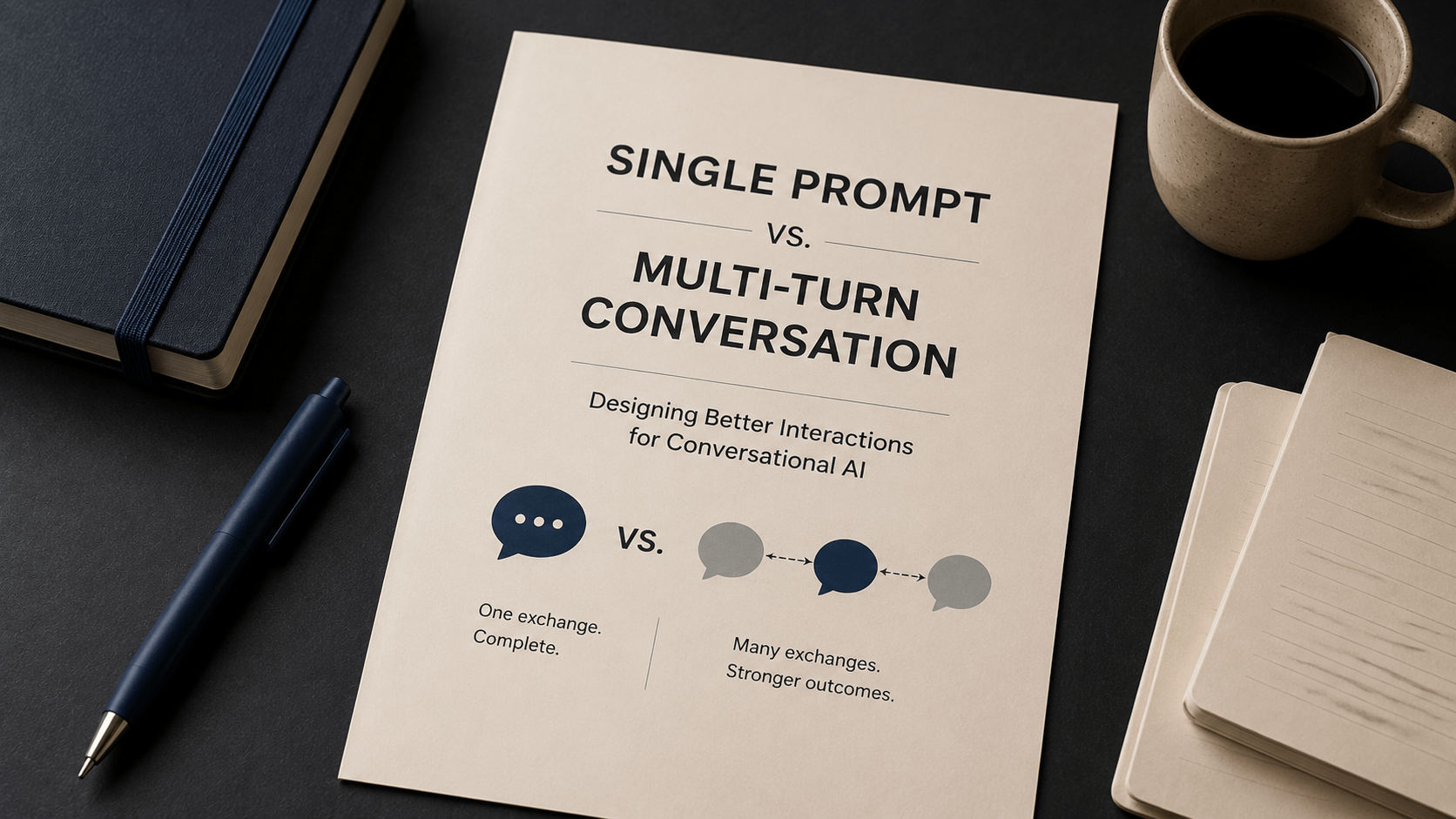
Introduction
Most people start with a single prompt. You type a question, the AI replies, and you get your answer. That works well for a wide range of tasks - drafting an email, summarizing a document, generating a list. Single prompts are fast, practical, and easy to iterate.
But single prompts have a natural limit. Some tasks require back-and-forth. Some goals take more than one exchange to reach. When a user's answer to one question determines what you ask next, a single prompt cannot do the job.
This is where conversational AI comes in. Instead of a single isolated request, you are designing an interaction - a sequence of exchanges in which each message builds on what came before. That shift changes what you need to think about as a prompt writer, and understanding it is the foundation for everything else in Chapter 5.
If you have worked through the single-prompt techniques in Chapters 3 and 4 - zero-shot prompting, role cues, the seven-element framework - this article is your entry point into multi-turn conversation design.
Why the Distinction Matters
The difference between a single prompt and a multi-turn conversation is not just technical. It shapes how you plan your work, how you structure AI outputs, and how you avoid some of the most common failure patterns in chatbot and assistant design.
Consider two scenarios involving the same goal - helping a customer with a product return:
Single-prompt approach: You write one prompt that includes the return policy, the question to answer, and the desired format. The model produces an FAQ entry. The task is complete in one exchange.
Multi-turn approach: You are building a customer support chatbot. Users arrive with different questions and different order details. The bot needs to greet them, understand their specific issue, ask a clarifying question, provide guidance based on their response, and confirm the outcome. That is four or five turns at minimum - and each turn depends on the one before it.
The second scenario cannot be handled with a single prompt. It requires a designed flow. And designing that flow requires a clear understanding of how multi-turn conversations work differently from one-shot queries.
How a Single Prompt Works
A single prompt is a self-contained request. You provide everything the model needs in one message: the task, the context, any constraints, and the desired output format. The model generates a response, and the interaction is complete. The conversational AI prompts you write for single tasks can be highly refined - but each one stands alone.
Here is a practical example:
| Prompt | You are a customer service writer. Write a short FAQ answer - two to three sentences - explaining ShopEasy's 30-day return policy for clothing items. Use plain, friendly language. |
| What this prompt contains | Role cue, task instruction, context (the policy), format specification, and tone guidance - all in one message. |
| Expected output | A complete, standalone FAQ answer. No follow-up required. |
The single-prompt model works well when the task is fully defined, the context is consistent, and the output can stand on its own. The seven-element prompt framework covered in Chapter 4 - role, task, context, format, tone, constraints, examples - gives you everything you need to build strong single prompts.
But what happens when the output depends on something the user provides? Or when the task requires guiding a user through a series of decisions? That is when the single-prompt model reaches its natural limit.
How Multi-Turn Conversations Work
In a multi-turn conversation, each exchange adds to a running record. The model uses that record - the full conversation so far - to generate each new response. You are no longer sending standalone prompts. You are building a sequence where every turn shapes what comes next.
Here is the same FAQ scenario, redesigned as a multi-turn flow:
| System message | You are a friendly returns advisor for ShopEasy. Keep responses brief and clear. Help with return and exchange questions only. |
| Turn 1 - User | Hi, I need to return something. |
| Turn 1 - Bot | Happy to help. What would you like to return, and what's the reason? |
| Turn 2 - User | A jacket I bought last week. It arrived in the wrong size. |
| Turn 2 - Bot | Got it. For clothing items, you have 30 days from delivery to exchange or return. Would you prefer an exchange or a full refund? |
| Turn 3 - User | Exchange, please. |
| Turn 3 - Bot | Great - I'll start the exchange. Can you confirm your order number so I can pull up the details? |
Notice what makes this different. The bot's response at Turn 2 is only possible because it received the user's input at Turn 2. The offer to exchange or refund only appears because the bot heard "wrong size." Each response depends on what came before. This is context accumulation - the central mechanism driving conversational AI.
Every message - yours and the model's - gets added to the running record the model uses to generate the next response. As the conversation grows, so does the record. That has practical consequences you will need to manage, which are explored in depth in Article 5-3.
Single Prompts vs. Multi-Turn: Key Differences
The table below maps the core differences across eight dimensions. Use it as a reference when deciding which approach fits your task.
| Dimension | Single Prompt | Multi-Turn Conversation |
|---|---|---|
| Structure | One message, one response | Sequence of exchanges; each builds on the last |
| Context source | Provided entirely in the prompt | Accumulates across the conversation |
| Design requirement | Write a clear, complete prompt | Plan a flow, manage context, define a persona upfront |
| Common use cases | Drafting, summarising, generating, explaining | Support bots, onboarding assistants, FAQ flows |
| Context window use | One request uses a portion of the window | Each turn fills more of the window progressively |
| Memory across sessions | Not applicable - each prompt is standalone | Base models: no memory. Tool-connected: may retain context. |
| Persona consistency | Defined per prompt as needed | Must be defined upfront and maintained across turns |
| Error recovery | Rewrite the prompt and try again | Insert a grounding prompt or start a new session |
Practical Application: Choosing the Right Approach
Here are five questions to help you decide which approach your task calls for:
- Does the output depend on user input you do not have yet? If yes, multi-turn is likely required.
- Is the task repeatable with the same context every time? If yes, a single-prompt template is often sufficient.
- Does the task require guiding a user through a process step by step? Multi-turn.
- Do you need the AI to refer back to something the user said two or three turns earlier? Multi-turn - and you will need to manage context deliberately.
- Is this a one-and-done task with a defined output - a draft, a summary, a list? A single prompt is typically the right fit.
Most professionals who use AI regularly are comfortable with single-prompt interactions. Moving into multi-turn design adds a layer of planning. You are not just writing a prompt - you are designing a flow that needs to hold together across multiple exchanges.
That planning starts with a system message - the instruction you set before the conversation opens. It continues with managing the context window as the conversation grows. And it extends to testing the full flow before it goes live. Each of those skills is addressed in the articles that follow in this chapter. This article provides the foundation: a clear understanding that single prompts and multi-turn conversations are different tools, suited to different tasks, with different design requirements.
A Note on AI Memory and Sessions
One distinction deserves special attention here, as it often catches many first-time conversation designers by surprise.
Base AI models do not retain any memory between sessions. When a conversation ends and a new one begins, the model starts with no knowledge of what was discussed before. User names, prior orders, previous preferences - none of it carries over. Each new session is a clean slate.
Tool-connected AI systems work differently. Depending on their configuration, they may store summaries, user preferences, or past interaction records that can be referenced in future sessions. But this capability requires explicit configuration. It does not happen automatically.
Never design a conversational flow that assumes cross-session memory unless you are working with a tool-connected system built to support it. Designing around a capability the model lacks creates failure modes that are difficult to diagnose and frustrating for users.
Key Takeaways
- Single prompts and multi-turn conversations are different tools. Single prompts are self-contained. Multi-turn conversations accumulate context across exchanges - each response depends on what came before.
- Multi-turn design requires planning a flow. The quality of later responses depends on how well earlier exchanges established context and direction.
- Context accumulation is the core mechanism. Every message fills more of the available context window. Managing that accumulation is an active part of conversational AI design.
- Base AI models have no memory between sessions. Each new conversation starts fresh. Cross-session continuity requires a tool-connected AI system explicitly configured to provide it.
- Choosing the right approach starts with understanding your task. If the output depends on user input you do not yet have, or requires guiding a user through a process, multi-turn design is likely the better fit.
What to Read Next
This article introduced the core distinction between single prompts and multi-turn conversational AI prompts. The next step is learning how to design the starting point of any conversational flow: the system message. Article 5-2 walks you through a four-component system message structure with a complete worked example.